Navigating Neurodiversity: How to Address Psychological Safety in the Workplace
By Kristin Follis
July 7, 2026

Kristin Follis is the Director of CLM & Legal Operations at CrushContracts and a member of the Corporate Legal Operations Consortium (CLOC)'s Inclusion & Social Impact Council. She has more than 15 years of in-house experience supporting innovative, fast-growing organizations across bio-technology, autonomous technology, aviation, and consumer products. Follis has built and scaled legal functions within both public and late-stage private companies, with deep hands-on experience spanning SPACs, IPOs, M&A, equity administration, and board governance.
At the Corporate Legal Operations Consortium (CLOC) Global Institute in Chicago that ran May 11-14, I participated in a panel with two colleagues and a room full of legal operations professionals. We did something our profession rarely does out loud: we talked honestly about how our brains work. The session was called “Navigating Neurodiversity,” and the ground rule was simple: this is a safe space. People shared lived experiences, the workarounds they’ve quietly built, and the moments they’ve thought, “I can’t keep this up” or struggled with imposter syndrome, burnout or other mental health issues.
I am one of those people. I am neurodivergent, and I lead legal operations. For most of my career those two facts felt like they were in tension with each other. They are not. What follows is part of what I shared in that room; for the general counsel and in-house leaders who weren’t there but lead neurodivergent people every day. Whether they know it or not, here is what you should know if you want to advance as a leader in a changing legal landscape.
What is neurodiversity?
“Neurodiversity” is a term that recognizes natural variations in how people think, learn, and behave. This perspective views conditions like autism, attention-deficit disorder/hyperactivity disorder (ADHD), and dyslexia as forms of human diversity rather than deficits. Embracing neurodiversity in the workplace fosters inclusion, innovation, and productivity. According to a Deloitte analysis from 2022, roughly 10%–20% of the global population is considered neurodivergent.
I was once told that neurodiversity accommodations were like physical ones: you get the accommodation you need and then everything goes back to normal, as if you were resting a broken leg. That is not how neurodiversity works. Accommodations have come a long way, with AI and apps that help us structure our days and tasks. Still, seeking an accommodation is largely an art form. Your doctor can help you adjust your daily routines to improve focus and ease stress, but these changes will not “cure” neurodiversity. To imply that an accommodation would “fix” a neurodivergent person reflects a misconception that many human resources/people teams take when approaching someone with mental health or neurodiversity. You don’t cure it. You adapt the environment to what that person needs, so they can thrive in the way their brain works.
Same brain, very different outcomes
Neurodivergence isn’t a single condition on a high-to-low scale. It’s a spectrum across many dimensions: executive functioning, sensory sensitivity, social differences, task avoidance, emotional regulation, perception, so two people with the same label can experience work in completely different ways.
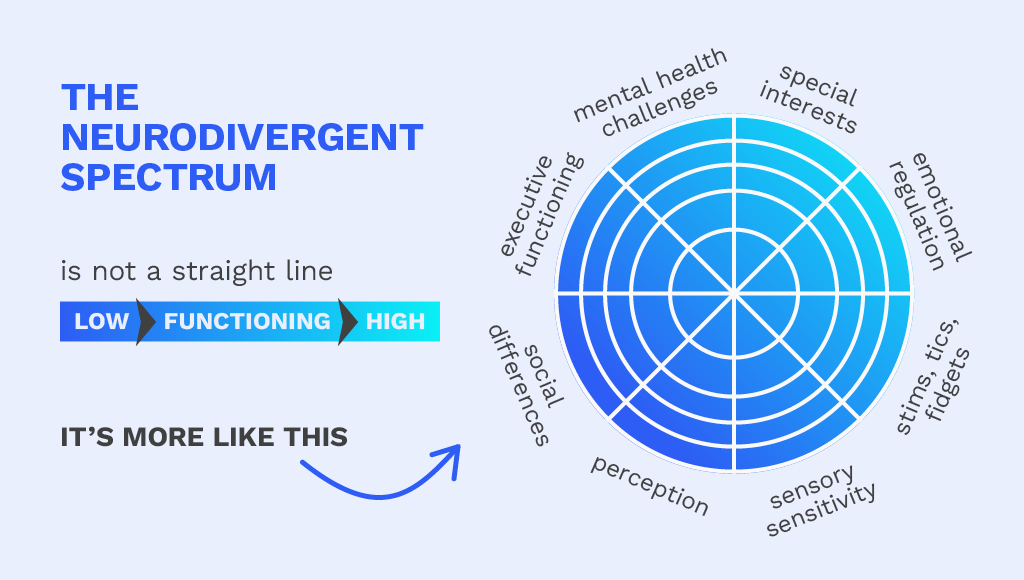
Here is the part that matters most for leaders: the same brain produces very different outcomes depending on the environment. Neurodivergent people are wired for a world built around “neurotypical” brains, so we are in a state of constant adaptation—and constant adaptation can become chronic stress. That is a large part of why neurodivergent professionals show higher rates of anxiety, depression, and burnout. Mental health and neurodiversity are deeply linked, but the lever is the environment, not the person.
Day to day, that adaptation often looks like:
- Masking: acting “fine” while burning through energy.
- Sensory overload: noise, context-switching, back-to-back meetings.
- Cognitive load: translating, re-reading, decoding unspoken rules.
- Executive dysfunction: difficulty with task initiation, working memory, emotional regulation, and time blindness.
- Rejection sensitivity: “feedback freeze,” people-pleasing, and misinterpretations.
- The crash: shutdowns, burnout, the “I can’t keep this up” moments.
None of this shows up on a status report. It shows up as a high performer who quietly leaves, and I’m here to tell you that you are missing the boat with your soft skills if you don’t know how to manage a person with neurodiversity. Secretly, it’s a superpower and I’ll tell you why.
Why neurodiversity is a gift
I can sit down and deep dive to fix many of the back-end issues that in-house teams would otherwise have to outsource to consultants or contract lifecycle management (CLM) vendors. I can painstakingly reconstruct workflows, tweak integrations, and perform user-acceptance testing. The downside? I can spend hours doing this and I am a perfectionist at my craft. In a fast-paced world where in-house teams run at roughly 1% of company headcount, they are constantly asked to do more with less, to get contracts out the door and “find time for organizing later.” Here’s what you’ll find: later never comes. Data-hygiene projects don’t get done. Temporary workarounds become the permanent fix, and the workload never stops.
General counsel (GCs) and chief legal officers need things fixed, but they must have the willingness to hand the project to someone who can do it, and then truly take their hands off the wheel and let them. I think this is something in-house leaders should examine in general: is the amount of control you keep over your direct reports healthy, and do you truly trust them? It must be difficult to supervise an area like legal operations without a technology or project-management background. Key performance indicators (KPIs) become hard to set, and frustration sets in on both sides: leaders don’t understand that tech fails and that failure is part of implementation, and neurodivergent people don’t feel heard or seen for the work they’re truly doing. Having spent years working with engineers, I can see the parallels: we think in systems, test obsessively, break things on purpose, and iterate until it works.
It was only when I moved to the consultancy side of the table that I could see clearly:
- Clients seek me out because of the tangible value my services provide.
- My neurodiversity is exactly what allows me to spot patterns, deep-dive into solutions, and explore new technology.
- I have a better understanding of in-house teams as clients, because each business has a unique set of needs based on its quarterly and yearly goals.
And finally: perfection is not the end goal. It is okay to get something to a minimum viable product or deliverable and turn it in. It will keep being iterated on, and as surely as the sun rises tomorrow, technology will change again, business priorities will be juggled, and we will pivot.
What this means for in-house teams and what you can do
If you lead an in-house team, the takeaway isn’t “go diagnose your people.” It’s that systems built for “neurotypical brains” leave gaps, and those gaps create silent risk. The errors, delays, and missed details that worry every GC are often design problems wearing the costume of “performance issues.” Your highest performers may be masking serious burnout right now. Legal operations is uniquely positioned to fix the system rather than blame the person, because we are the ones who design how the work actually flows.
The business case is not subtle:

Psychological safety from management is what makes the difference. When people don’t have to spend their energy hiding how they work, they spend it on the work, and the whole team gets the benefit of how differently we all think. Support for your team may look like:
- Having diverse employee resource groups (ERGs) available at your company, or encouraging them as an executive sponsor.
- Ensuring that your company has policies and best practices for people who need to request accessibility assistance (for example: AI note taking features for meeting recaps of action items, project management tools, putting instructions in writing etc.).
- Fostering an open-door policy where your direct reports can come to you if they are struggling with an assignment, and working with them to find the style they need to work best.
For further information about neurodiversity, check out the following resources:
Must read intelligence for general counsel
Subscribe to the Daily Updates newsletter to be at the forefront of best practices and the latest legal news.
Daily Updates
Sign up for our free daily newsletter for the latest news and business legal developments.