Meet the Expert: Mark Clews on Digital Evidence, Defensible Discovery and What Comes Next
August 25, 2026
Sponsored Content
Presented by iDiscovery Solutions, Inc.
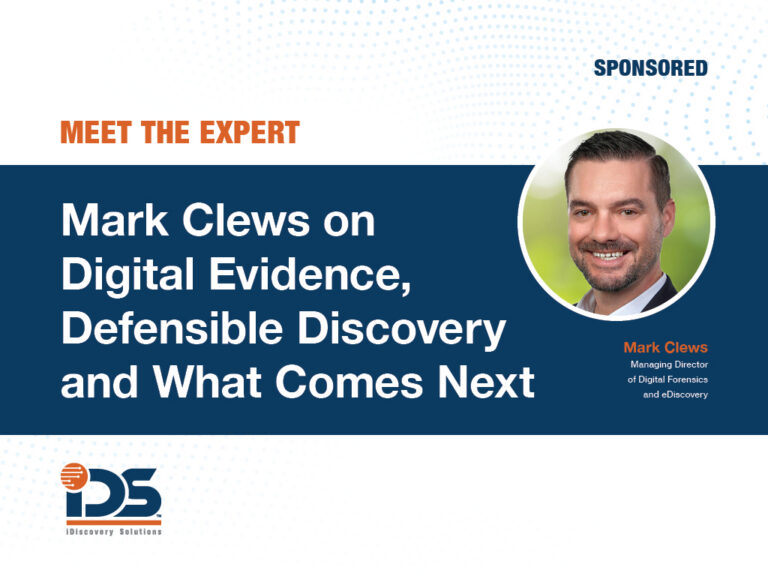
In April 2026, Mark Clews joined iDiscovery Solutions (iDS) as Managing Director of Digital Forensics & eDiscovery, bringing more than two decades of experience investigating, preserving, and interpreting digital evidence. In this installment of iDS’s Meet the Expert series, Clews shares the career path that brought him to digital forensics, his approach to defensible discovery, and the emerging issues legal teams should have on their radar.
How did you first get into eDiscovery and digital forensics?
Mark Clews: My path was a bit unusual. I started as an accountant in London at BDO, then moved into the firm’s Litigation Support Department, which handled forensic accounting and investigations involving white-collar fraud, money laundering and other financial crimes. What fascinated me wasn’t the numbers; it was the detective work behind them. Every fraud case told a story, and my job was finding the truth buried in the documents.
After Enron’s collapse, BDO absorbed part of Arthur Andersen’s London team. That introduced me to Phil Beckett, one of the leading digital forensics professionals in England. He became my mentor, and together we built BDO’s European Digital Forensics practice. We later launched Navigant Consulting’s Digital Forensics and eDiscovery practice in London. I transferred to Southern California in 2009 and spent the next several years building the West Coast team, which eventually became part of Ankura.
After 17 years across Navigant and Ankura, I was excited by what iDS was building: a firm with the technical depth and entrepreneurial energy to stay ahead of where the industry is going.
How do you explain what you do to someone unfamiliar with eDiscovery?
Mark Clews: When companies end up in a lawsuit or investigation, the evidence is almost never in a filing cabinet anymore. It’s in emails, texts, chat messages, shared documents, and the systems that track them. My team finds that evidence, protects it so it can’t be challenged later, and explains what it actually shows.
What is the most important thing a legal team should understand about digital evidence?
Mark Clews: Context is everything. Data has no agenda, but it also doesn’t explain itself. A timestamp, file access log or hash value is a fact, but facts only become evidence when you understand the system that generated them.
The same data point can support very different stories. A file modified at 11:47 p.m. might reflect an employee working late or deliberate exfiltration before resignation. A forensic examiner’s job isn’t simply to pull the data. It’s to corroborate it, test alternative explanations and understand platform-specific quirks that can make innocent activity look suspicious or allow misconduct to hide in plain sight.
How early should eDiscovery strategy be introduced?
Mark Clews: As soon as litigation is reasonably anticipated. “Preserve early” does not necessarily mean “collect everything immediately.” Modern cloud platforms often allow data to be preserved in place, which lets teams prioritize based on volatility.
Social media is a good example of data that may not be able to wait. It is constantly changing, and private content such as direct messages can be ephemeral and platform-controlled.
What is the biggest misconception attorneys have about discovery?
Mark Clews: That the safest move is always to collect everything. Over-collection creates its own risks: blown timelines, inflated review costs. The strategic move is defensible by design: collect deliberately, understand what is at risk of being lost, and be able to explain later why something was or wasn’t collected.
What is your view on AI-assisted review?
Mark Clews: AI-assisted review is genuinely valuable, particularly for early case assessment, surfacing likely relevant documents and generating leads. But I would not rely on it alone for key evidence, and I would not put anything into a court filing that had not been independently validated by a human reviewer.
Newer generative tools can produce fluent summaries, privilege rationales and answers about a collection. The danger is not that AI gets it wrong. The danger is that AI gets it wrong confidently, and no one catches it. Human validation is not a limitation of the technology; it is the standard the work should be held to.
How should legal teams think about deepfakes and AI-manipulated media?
Mark Clews: As visual cues become less reliable, forensic analysis becomes more important. We look at things like metadata, compression artifacts and other technical inconsistencies. No single indicator is necessarily dispositive, so authentication requires looking at the evidence as a whole. The shift is that we’re increasingly asked to establish proof of origin rather than chain of custody. Chain of custody assumes a file that can be traced and re-verified; generative output is probabilistic and doesn’t reproduce the same way twice. That doesn’t put authentication out of reach; it means methodology carries the weight.
What emerging issue do you think the industry is not discussing enough?
Mark Clews: Influencer data. Brands increasingly rely on influencers, but those individuals often control their own data across multiple platforms without a corporate IT department behind them. If a dispute arises, preserving posts, messages and related data can become complicated very quickly.
Brands should think about preservation before a dispute occurs. Contracts need to contemplate how evidence will be preserved when the relevant custodian is not an employee and the data may be personally controlled, platform-dependent or easily deleted.
What made iDS the right move for you at this point in your career?
Mark Clews: I wanted to be somewhere the technical work and client relationships weren’t separated by layers of internal process. At iDS, senior consultants are hands-on and work closely with the data. Experts led by experts, not experts managed by people who never did the work.
The emphasis at iDS is on researching new technologies, anticipating what is coming and giving clients direct access to experienced people who are close to the evidence. Tech enabled, not tech dependent: the tools move fast, but judgment still decides what the evidence means. That is the kind of environment I wanted to be part of.
Continue the conversation
To talk through a matter where digital evidence is central, reach out to the iDS team or Mark directly at mclews@idsinc.com.
Truth Through Data. Where expertise leads, defensible outcomes follow.


Must read intelligence for general counsel
Subscribe to the Daily Updates newsletter to be at the forefront of best practices and the latest legal news.
Daily Updates
Sign up for our free daily newsletter for the latest news and business legal developments.