Workiva’s Josh Gertsch Talks AI Readiness, Risk, and Legal Judgment (Part 1)
January 27, 2026
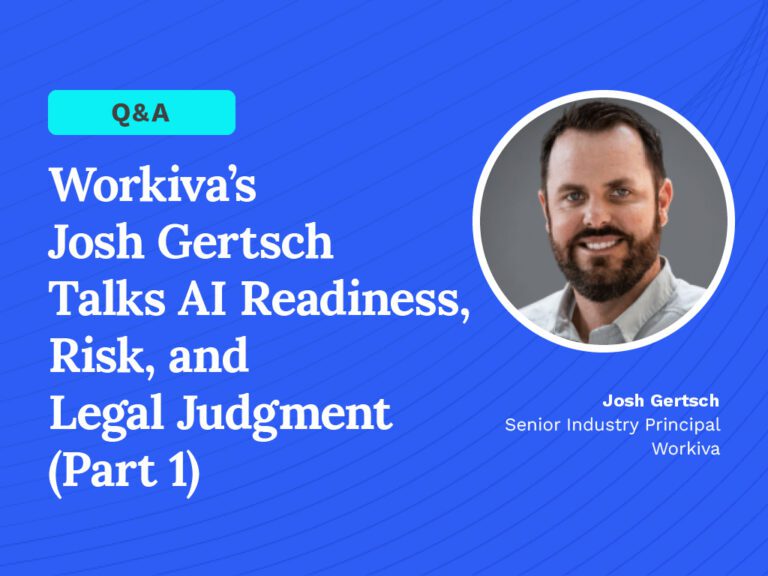
Josh Gertsch is a senior industry principal at Workiva, where he supports capital markets teams navigating complex transactions. With a background in law and accounting, he focuses on applying technology to streamline deal workflows, reduce risk, and improve collaboration across legal, finance, and compliance functions.

Sponsored Content
Presented by Workiva
In this interview, Workiva’s Josh Gertsch explains why AI readiness, not speed, is the real challenge facing legal teams today. As organizations rush to deploy generative tools, he outlines how data foundations, governance, and human judgment determine whether AI actually adds value. The conversation arrives at a moment when AI readiness has become a board-level issue for legal and compliance leaders. You can read the second part of the interview here.
To kick things off, could you share a bit about your role at Workiva and give us a quick overview of what Workiva does? From your perspective, what makes Workiva particularly relevant to attorneys and legal teams?
Josh Gertsch: I’m a senior industry principal at Workiva, supporting our capital markets group. I come from a background in law and accounting and joined Workiva about five years ago, where I’ve helped lead our deal and transaction processes.
At Workiva, we develop technology that helps deal teams navigate complex workflows throughout the transaction lifecycle. If filings need to be submitted to the SEC, our platform supports that process. More broadly, we help deal teams made up of accountants, attorneys, investment bankers, and stock exchanges automate and streamline their work. The goal is to bring everyone together on a single platform to manage the entire process more efficiently.
While capital markets are a core focus, that same approach extends across financial reporting, governance, risk, compliance, and sustainability. Across all of these areas, the goal is the same: reduce manual work, minimize risk, and give legal teams confidence that the information they’re relying on is accurate and up to date.
Capital markets, financial reporting, governance, risk, compliance, and sustainability are the pillars of our business, and across all of them, our focus is on bringing innovative technology to traditionally complex and manual processes.
From your vantage point at Workiva, how have you seen technology evolve within the legal space? What shifts or advancements stand out most in recent years?
Josh Gertsch: In my time at Workiva, I have been looking at the legal space very much through a technology lens, and there has been a meaningful change in how attorneys approach technology. Historically, attorneys have been among the last professions to adopt new tech. There’s real risk involved, and some of that hesitation is justified, but adoption was slow for a long time.
Before COVID, progress felt fairly limited. We saw some movement in areas such as contracting, contract management, and billing, largely focused on administrative tasks. But when COVID hit, everything changed almost overnight. In-person meetings stopped, teams were suddenly working across the country, and cloud-based platforms became a necessity rather than an option.
That shift had a major impact, especially in areas like securities law. Teams could no longer gather in war rooms or boardrooms; everything moved to conference calls, remote collaboration, and working across time zones. We saw this firsthand in our own customer base. At the same time, legal teams handling litigation and risk management had to rethink how they navigated the courts and other processes. There was a broad realization that technology was now essential.
Over the last five years, and especially in the past year, AI has been the real catalyst accelerating this shift. There’s no going back. Once AI entered the picture, it became impossible for attorneys to ignore. Everyone is now looking at how to leverage it. AI is powerful, but it works best when it’s integrated with other technologies. To be truly effective, it needs the right foundation.
What we’re seeing now is a genuine mindset shift. Attorneys across practice areas are saying they already use general AI tools. But when it comes to applying AI in a professional setting, they’re dealing with proprietary and highly sensitive information that can’t simply be dropped into open systems. The question becomes: how do you enable AI while protecting that data? And the answer lies in having secure, baseline technologies in place that allow AI to be used safely and effectively, so it can actually take legal work to the next level.
There’s now a push back to the office or at least to hybrid work. Do you think being forced to work remotely during the pandemic taught legal teams anything lasting? Even as people return on site, has that experience reinforced the value of technology? And do you think that buy-in will stick? As you said, with AI, there’s no going back?
Josh Gertsch: One of the most interesting post-COVID trends we’ve seen shows up clearly in capital markets transactions, particularly IPOs. An IPO typically involves a fully assembled deal team: two or three law firms, in-house counsel, accountants, marketers, and others. Five years ago, those teams were usually regional. If you were doing a deal in Seattle, you could assume many of the advisors were based there.
COVID completely changed that dynamic. Suddenly, advisors didn’t need to be in the same city, or even the same time zone. While New York historically dominated deal activity, we’ve seen meaningful shifts to markets like Houston, Denver, and other regions handling large, complex transactions. Geography matters far less than it used to.
Even though there’s been a significant return to the office, we’re not going back to strictly regional deal teams. That part is permanent. Companies can now choose the attorneys and advisors that best fit their needs, regardless of where they’re located. In many cases, you may never even meet your outside counsel in person, and that’s now entirely acceptable. Once that line was crossed, there was no reason to reverse it.
Where do you see the greatest opportunities for technology, especially AI, to support legal teams today? Which parts of the legal workflow are most ripe for efficiency gains, risk reduction, or meaningful improvement??
Josh Gertsch: When you look at how attorneys work, most practices revolve around a core set of activities. In securities law, which is where we spend most of our time, every deal involves due diligence, drafting agreements, and filing those documents with regulators: registration statements, disclosures, and related materials.
Technology already plays a role in tying those steps together, and AI is accelerating that integration. Legal work is largely about drafting, reviewing, managing risk, and ensuring required elements are addressed. Those tasks are time-intensive and often repetitive. Technology helps remove friction, and AI builds on that by reducing the most tedious parts of the process.
As AI matures, we’re seeing real progress in areas like contract drafting and management. You can input negotiated terms, key deal points, or an MOU and ask AI to generate a draft under a specific legal framework. It won’t be perfect, and it still requires expert review, but reviewing is far faster than drafting from scratch. Even if AI gets you 50 or 60 percent of the way there, that’s a meaningful efficiency gain.
Across contracts, litigation, and securities filings, cutting hours or days from these workflows helps deals move faster and cases resolve more quickly. That alone has the potential to break long-standing bottlenecks in the legal system.
AI is reshaping professions across the board. How should attorneys think about their role in their work? Which tasks are best suited for augmentation, and which still demand exclusively human judgment or technical expertise?
Josh Gertsch: AI is absolutely changing the landscape, but we’ve also seen a bit of whiplash. Early on, there was a rush to adopt it. More recently, there’s been a clearer understanding that AI is only as good as the data and context you give it. Without that, it can be unreliable.
A simple example: if you ask AI what a unicorn eats, it will confidently give you an answer even though unicorns don’t exist. That illustrates the point. AI is powerful, but it’s still unbridled in many ways. For lawyers, the value lies in low-stakes, non-judgment-based work. That’s where adoption has been building for years, and now it’s accelerating.
Can AI help draft 60% of a long agreement? In many cases, yes. But it doesn’t replace months of strategic thinking or deep subject-matter expertise. There was a comment last year suggesting AI could handle 90 percent of a registration statement, and most advisors pushed back on that. Strategy, positioning, and judgment still matter too much.
What AI does well is remove the routine work. It clears space so attorneys can focus on what actually requires experience and insight. Over time, it will get better, but today, it’s a complement, not a substitute.
What aspects of legal work still clearly require human judgment? If technology can get us halfway there, where does AI still fall short?
Josh Gertsch: In law, and accounting as well, the challenge is that rules and regulations aren’t black and white. They require interpretation and judgment. AI can handle boilerplate and structure, but it can’t fully replicate how professionals weigh facts, apply nuance, and build an argument.
What AI does well is get you to the critical decision points faster. Instead of worrying about formatting or standard language, attorneys can focus immediately on the five or six key judgments that matter most. Those are the moments where you’re interpreting a statute, applying facts and circumstances, and deciding how a position should be framed under the law.
AI can try to do that if you prompt it, but the result is often too generic. Experienced attorneys can spot it immediately. It can frame the issue and set the stage, but it can’t push the argument over the finish line. When you compare an AI-generated version to one written by an attorney, the difference is usually in that final 20 percent, the nuance, the reasoning, the judgment. That’s where things truly click, and that’s where human expertise still makes all the difference.
You touched earlier on the war room, the human work of negotiating, aligning stakeholders, and shaping a deal. AI can help draft the output, but it can’t originate the deal or navigate the nuances. That still feels distinctly human. At the same time, attorneys are famously risk-averse. Do you think the bigger question isn’t when AI becomes capable, but when attorneys trust it enough to rely on it? It’s hard to imagine a world where someone doesn’t still say, “I’m going to review this one more time.”
Josh Gertsch: There’s definitely a level of control involved. I wouldn’t frame it as a flaw, but attorneys do tend to hold onto that control, and for good reason. In deals, there’s a moment we often talk about as “who holds the pen.” Toward the end of a transaction, it’s almost always the attorneys holding it. That’s where nuance really matters: how things are worded, how positions are articulated, how risk is framed. Those decisions ultimately steer the direction of the deal.
To your point, I don’t think attorneys will ever fully relinquish that role, and honestly, that’s part of their value. This work can’t and shouldn’t be fully automated. These are human decisions that require judgment. Do we really want AI making final calls on how facts and circumstances are interpreted or how an argument is positioned? The answer is no. There will always be a need for someone to review the situation, apply experience, and make the strongest case possible. That final layer of accountability is not something attorneys are going to give up.
As AI becomes more embedded in legal workflows, responsible use is increasingly important. What should legal teams be thinking about when it comes to data security, confidentiality, explainability, and accuracy as they evaluate AI-enabled tools?
Josh Gertsch: This is where AI is likely to face the most resistance and where adoption naturally slows down. We see this constantly. We’re in the market every other week, meeting with executives, often including general counsel, talking about strategy and the problems they’re trying to solve. This year, nearly every one of those conversations has centered on AI.
Everyone wants to deploy it everywhere, layer it on top of existing systems, and move fast. But once you dig in, issues start to surface. Data is inconsistent. Inputs are flawed. AI does exactly what it’s designed to do: it interprets and drafts. But if the underlying data is wrong, the output will be too. That’s the real challenge. AI isn’t the problem; it’s that the organization isn’t ready for AI.
Data is everything. Do you have the right data flows? Are controls in place? Can sensitive information be securely housed? For legal teams, open AI systems accessing proprietary or confidential data is simply not acceptable. That means organizations need strong foundational systems, whether that’s an Enterprise Resource Planning (ERP) system, a contract management platform, or another core system that governs, certifies, and protects data.
What we saw this year was a sharp shift. Early on, the mindset was “run everything through AI.” By the end of the year, it became “we need guardrails.” Companies realized they had to fix their processes and data architecture first, then layer AI on top. That’s when AI becomes powerful, when it’s tailored to your business, not just a general public tool.
This isn’t new. Even before AI, organizations often tried to throw technology at broken processes. AI has simply forced a reckoning. And what’s changed is the pressure coming from the boardroom. Governance and risk have always mattered, but now the urgency is real. Boards want AI implemented, and that means leaders have to solve these foundational issues. AI didn’t create the data problem, but it exposed it in a very visible way.
Technology is also reshaping how legal teams collaborate with finance, compliance, and external advisors. How do you see AI and modern platforms changing cross-functional collaboration, decision-making, and the speed and quality of legal work going forward?
Josh Gertsch: I’ve always thought of technology as solving two core problems. The first is data: how do you move accurate information from point A to point Z? The second is workflow: how do you bring the right people together at the right time with the right visibility so work moves efficiently?
If you get the data right, you’ve already solved a large part of the workflow challenge. Everyone can see the same information in one place. From there, it becomes about curation: creating an environment where legal, finance, compliance, and other stakeholders can collaborate effectively.
Years ago, functions operated in silos. Legal stayed in legal. Accounting stayed in accounting. That world doesn’t exist anymore. Today, nearly every initiative is cross-functional. Committees, working groups, and deal teams cut across departments by default. Managing that complexity requires a shared platform.
That’s where modern workflow tools, and eventually AI, come in. AI can help structure drafts, align inputs, and surface what matters most. Ideally, data gets you halfway there. Workflow platforms solve another significant portion by organizing collaboration. Then AI helps contextualize and assemble the work.
What that leaves is the final 10% to 20%, the part everyone actually wants to do. The judgment, the strategy, the expertise. That’s why people went to law school. If technology can handle the rest, the entire process moves faster and improves in quality. In theory, it should dramatically accelerate how decisions are made and how work gets done. And that’s the real opportunity ahead.
Read the second part of the interview here.
Must read intelligence for general counsel
Subscribe to the Daily Updates newsletter to be at the forefront of best practices and the latest legal news.
Daily Updates
Sign up for our free daily newsletter for the latest news and business legal developments.