CLOC’s Oyango Snell Talks Legal Ops Evolution, AI Governance Ahead of CGI Chicago
April 27, 2026
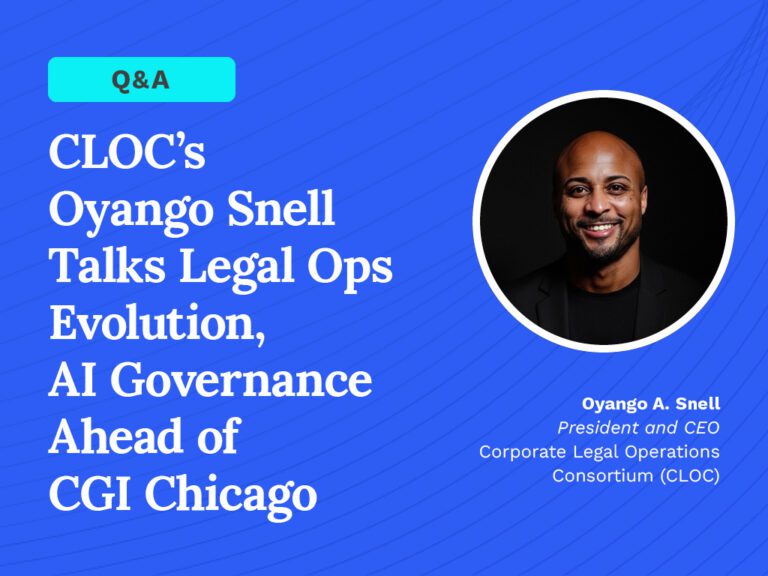
Oyango A. Snell is the President and CEO of the Corporate Legal Operations Consortium (CLOC). A lawyer with nearly 20 years of experience across law firm, in-house, government, and executive association roles, he is recognized internationally for his leadership and transformative impact.
Published in Today's General Counsel, May/June 2026
In this interview, Oyango A. Snell of the Corporate Legal Operations Consortium (CLOC) shares insights about what attendees can expect at the CLOC Global Institute (CGI), which runs May 11-14 in Chicago. He also discusses the legal ops evolution as well as leadership and governance developments at CLOC.
You’ve recently transitioned into the executive role from executive director to president and CEO. How does this structural shift specifically empower you to scale CLOC’s global influence and better serve a community that is now more than 6,500 members strong?
Oyango A. Snell: There are several things to consider when we talk about the structure of any business. The goal of governance is to be the underlying core facilitation on how decisions get made, how the business moves forward, and how each of the parties within the organization interacts.
When we looked at CLOC’s previous structure, leadership was involved in many operational functions. As the organization has matured, we wanted to look more broadly at the businesses that we actually represent—our members—as well as other associations and how they’re structured to meet the demands of their membership.
In looking at how we could modernize our governance to meet the maturation of our association and our industry, we looked at what titles help the organization get to the meat of the matter: How does it help us scale and perform in a way that meets the demand of our membership? The new title reflects that evolution. It’s not just about scaling; it is about ensuring that we’re able to serve our members as well as key stakeholders who are part of this industry, whether they’re members or not.
CLOC is a leader in the legal ecosystem. Having a president and CEO who has the ability to speak to those different components of the industry was important; that’s really what helped elevate the role. We’ve worked to make sure that we had that executive-level presence in the position to lead in that way. As people adjust to the structure, it puts us in a position to serve as the authority on legal ops.
When people hear the title “executive director” it can carry different meanings. We’re not a charitable-type nonprofit. That’s not to say that executive directors are not great leaders; some are my mentors. However, as CLOC has matured over the last 10 years, it was important for us to be viewed as the industry leader not just within the United States, but beyond. Sometimes the term “executive director” has conflicting meanings in other countries. It’s not always meant to be the chief executive officer; sometimes it refers to someone further down the chain of command. Everybody understands what president and CEO means as far as leading an organization and an industry.
You just announced that the board of directors expanded to its largest size in history—16 members. How are you ensuring that this diverse group of voices translates into faster, more agile decision making?
Oyango A. Snell: People often assume that more board members create complexity, but in practice it improves flexibility. When you have a small board, you have to rely on everyone’s schedule aligning to move the business forward. In order to reach a quorum with a small group, you almost have to have everybody.
With a larger board, you’re able to be more nimble and agile. You can get to decisions quicker because, although it takes effort to convene more members, it’s easier to get a quorum out of 16 than it is to get all five or seven of a smaller leadership group. From the structure itself, it makes it more efficient to get to decision making.
As far as the methods we are employing to ensure those diverse voices get heard, it’s no different than our established processes. Everybody has an opportunity to bring their expertise and their entire authentic self to CLOC. If they see something within the industry that we need to focus on, we pause and create space for those conversations, whether it’s a visionary concept or something practical.
Part of this shift was also stepping into a new way of governance. The board used to be hands-on, helping to make decisions that our staff now makes—like planning our global institute or hiring. Those roles have had fine lines drawn. The board is designed to govern as fiduciaries, ensuring CLOC’s assets, management, leadership, vision, and strategy are intact. That delineation of responsibility—with the board governing and the team executing the strategy—is really important for us. It has helped capture those diverse voices and lead to better decision making at an appropriate level.
Moving CGI from Las Vegas to Chicago is a massive symbolic and logistical shift. How does the “Stronger by Design” theme reflect the current maturity phase of legal operations, and what should a longtime attendee expect?
Oyango A. Snell: Moving from Las Vegas to Chicago was a very tough decision. From the outside looking in, people might ask: “If it ain’t broke, why fix it?” But although it wasn’t broken, it had gaps—one being access. Not everybody in the legal ecosystem can access Las Vegas, whether because of finances, geography, or company cultures that don’t support conferences in a “party city.”
Regardless of location, conferences serve the same core purposes: professional development, networking, and building relationships. But our members shared that it’s difficult for them to get approvals for Vegas. We listened and explored other cities, which led us to Chicago.
Chicago’s central location makes it easier for more people to attend. I recently spoke to a professional in LA who has never been to the Vegas CGI but is coming to Chicago. It brings a different accessibility, and the theme “Stronger by Design” ties into the intentional transformation and growth we’re seeing in our industry.
Chicago is the perfect backdrop. It was rebuilt with a master plan, and legal ops is doing the same thing. We’re moving from “doing more with less” to doing it better by designing intentionally and becoming more strategic. We are looking at how the entire enterprise makes decisions, modernizing our operations to impact the bottom line. We used the Chicago architectural footprint as a blueprint to mirror how our industry has been intentional by design.
We’ve moved from an inflection point into a phase of transformation. We understand the technological advances we need while we work to understand how AI impacts that. We’re no longer trying to just “figure it out” or fighting for a seat at the table. We have a seat, and we’re working with general counsel and CEOs to drive the business.
CGI is introducing an exhibit hall-only pass and an AI stage. How are you re-engineering the relationship between buyers and providers?
Oyango A. Snell: CLOC has taken intentional steps to be all-encompassing, including law firm representatives and vendors in our membership and leadership. As the premier association for legal ops, it’s important to understand how we’re working with these components to solve day-to-day business problems.
In Chicago, our exhibit floor is designed to be more educational, not just about hard sales. It’s an opportunity to understand the products that can help businesses thrive. We want open conversations between legal ops professionals and tech vendors about the struggles they face so we can work together toward creative solutions.
We introduced the single-day access pass to the exhibit floor to facilitate that relationship development. This also ties back to access. We want to bring in local communities from neighboring states who can drive in for a day, get the information they need, and return home the same day. We didn’t have that direct local component in Vegas. Chicago serves as the central hub to bring these different people together.
With the new AI-focused elements at CGI, how is CLOC moving the conversation from “What is AI?” to “How do we design governance for it?” What is the biggest hurdle for legal ops leaders?
Oyango A. Snell: Great question. Last year, the conversation was: “Should we even be using AI?” I’ve been trying to get people away from the fear element. We’ve shifted from “Are we using it?” to “Why are we using it? How is it driving decisions and helping us scale? How are outside law firms using it to help clients make better business decisions?”
We’ve adjusted from fear to use cases. On the floor, we’ve created opportunities for demonstrations of AI products currently in use. People will get a chance to see success stories and best practices regarding integration, as well as the challenges involving budgets and adoption.
At our recent Europe summit, I learned that participants are really dialed into how clients are using these products. AI has existed for years, but we’ve only started talking about it this way recently. The fear was mostly driven by not understanding when or why to use it. They need to know: How does it help me make better business decisions? CLOC is listening to these trends. We want people to walk away with practical analysis they can take back to their teams for implementation on day one.
How is CLOC moving beyond representation to ensure diverse perspectives are baked into the design of legal operating models?
Oyango A. Snell: In my leadership roles, I have never needed a policy or a quota to do the right thing. You do the right thing because it’s the right thing. Diversity is in my DNA; I actively seek different perspectives to move the business forward.
There is an intentionality in our team and board to include diverse voices. Diversity means a tolerance and respect for difference, but other components are equally important: inclusive practices and equitable access to resources and opportunities.
Our board and councils represent significant diversity in gender, generation, race, religion, and industry. What’s great is that CLOC is a peer member-driven organization. For example, our educational programs are decided by a diverse group, but they are scored anonymously. We aren’t elevating projects based on who is presenting; we’re looking at what the industry needs. I’m proud to have a board dedicated to keeping that intentionality at the forefront.
We look at the entire industry. Through a survey we partner with Harbor on, we are learning that demand is rising sharply in key areas like regulatory and cybersecurity issues. Yet, only 37% of departments expect to increase outside counsel spend. When we see those challenges, we have to ensure those diverse voices are helping solve the actual business problems our member companies face.
A year after the Chicago edition of CLOC, what is one tangible framework you hope the community will have adopted?
Oyango A. Snell: I love the “Chicago edition” framing. I’m going to adopt that one. Putting you on notice. If there is one thing I want people to recognize, it’s that the legal ops industry, through CLOC, is unifying the entire industry in a unique way.
Legal ops has moved from the back office to the flight deck of the enterprise. It has grown from administrative work to decision-making, financial management, and data protection. Currently, 80% of legal departments rank technology strategy among their top priorities. Those numbers reflect the growing strategic role of legal operations.
I hope those coming out of the Chicago edition understand the complexity of this field. They are part of a transition from an inflection point to the execution of technological components. We must grow our industry intentionally by working together.
My message is one of unification to solve today’s business problems. I hope each person takes one thing from the conversations we are facilitating back to their offices to immediately enhance their organization’s business decisions.
Special Edition on Legal Operations out now!
Must read intelligence for general counsel
Subscribe to the Daily Updates newsletter to be at the forefront of best practices and the latest legal news.
Daily Updates
Sign up for our free daily newsletter for the latest news and business legal developments.