Littler’s Stephan Swinkels Talks US Policy Impact on European Employers
March 6, 2026
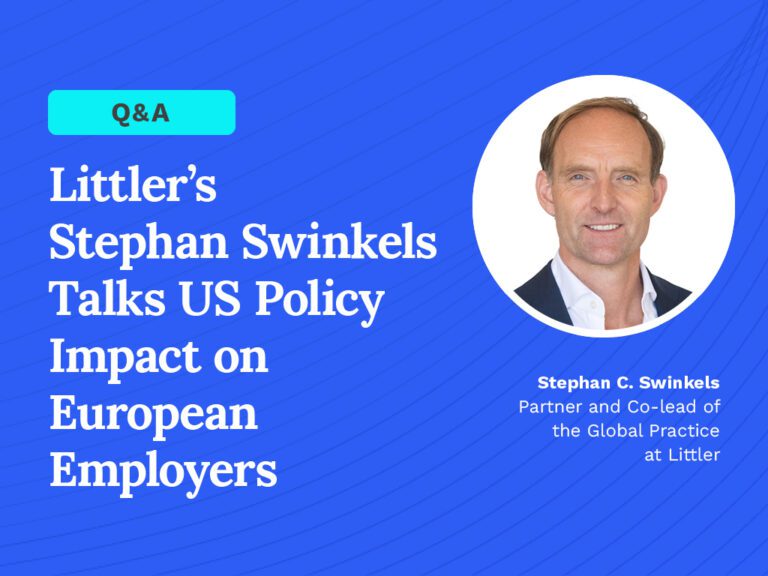
Stephan C. Swinkels is a partner and co-lead of the Global Practice at Littler. He has advised on restructurings, compensation and benefits matters, global mobility, social media policies and health and safety issues. Swinkels has a particular focus on international law, including cross-border issues and multi-country compliance.
In this interview, Littler Partner Stephan Swinkels discusses US policy impact on European employers at a moment when multinational companies are rapidly reassessing workforce strategy, mobility, and inclusion efforts. Drawing on findings from Littler’s European Employer Survey, Swinkels explains why US policy volatility has moved from a political concern to a board-level employment risk—and why general counsel are being pulled to the center of these decisions now.
The survey shows that 75% of European employers with US operations have already adjusted their US-focused workforce strategies in response to recent policy changes. What does that tell you about how seriously European employers are taking the current US policy environment, and which adjustments stood out most to you?
Stephan Swinkels: I’ll be honest, I was slightly surprised by how high that percentage was. It shows that European companies with US operations aren’t just reacting emotionally or relying on headlines. These are employers with real, lived experience in the US market, and they’re already feeling the impact on their operations. And we’re only one year into the new administration.
This has been taken very seriously. Even in the run-up to the election, European employers were paying close attention because the choice felt stark, two very different directions, with very little middle ground. Many companies were already preparing for one of the two outcomes. Once the election results were clear, there was a very rapid learning curve in Europe. Suddenly, everyone was talking about executive orders, presidential powers, and agencies like the US Equal Employment Opportunity Commission (EEOC) or the National Labor Relations Board (NLRB), institutions that many European employers had never dealt with before. But they learned fast, largely because this was headline news across Europe.
The seriousness of the new direction pushed these issues straight to the boardroom. General counsel, CEOs, and senior leaders became directly involved. It’s been taken very seriously, especially because of the impact on people. Geopolitics had already started entering the workplace before this, but this was by far the biggest example.
In terms of adjustments, I’m seeing almost everything change. The historically close relationship between Europe and the US has been strained. European employees traveling to the US for conferences or meetings are now being advised to be careful with their laptops, use phones, and carry printed hotel reservations and return tickets. That’s not how they would typically prepare for business trips. It’s a major hurdle.
We’re also seeing clients ask questions that would have been unthinkable a year ago: “My sales team is going to the US for a conference. What do you advise?” That question simply didn’t come up before. As a result, there are examples of companies moving events out of the US and into Canada or Mexico or elsewhere. Large organizations don’t want to take the risk that one or two people or more might run into trouble at the border.
Another major change is in secondments and temporary assignments. Opportunities to send European employees to work in US offices, like New York, have nearly vanished. Companies are saying, “You can work wherever you want, just not in the US.” Even though there aren’t many concrete examples of things going wrong, the uncertainty alone is enough to alter behavior. Employers feel responsible for their staff, and that uncertainty makes them hesitant to send anyone into a situation they can’t fully control.
One-quarter of respondents reported canceling or reducing business travel to the US, and the same percentage said they are reducing US operations altogether. From an employment-law perspective, how significant are these moves, and what risks or trade-offs do employers appear to be weighing?
Stephan Swinkels: These are very significant moves, and they reflect how fundamentally mobility has changed. It’s become much harder to send people to the US than it was even a year ago. In many multinational companies, teams still operate globally; whether someone sits in New York, London, or Frankfurt, they’re part of the same team. But the practical reality of moving people back and forth has shifted dramatically.
And it’s not only European employees who are hesitant. We also see Americans who are reluctant to travel abroad. People on visas or green cards, or those who have traveled to countries that are now viewed as less friendly, worry about whether they’ll be allowed back into the US. That fear affects mobility in both directions.
From an employment law and compliance perspective, reduced travel introduces real risks. Teams cannot operate entirely virtually. If I’m managing a US-based team from Europe, I can oversee them, but not in the same way I could if I were regularly on the ground. That leads to less oversight, less control, and a greater risk that issues go unnoticed. Investigations are a good example. In the past, someone would fly in, address the situation, and resolve it quickly. That approach is more complicated now.
Travel hasn’t stopped altogether, but it’s scrutinized far more closely. Every business trip has to be justified, and increasingly the decision is made not to go. That lines up exactly with what we see in the survey.
The survey also mentions decreasing of US operations. When employers go further and begin reducing US operations, the legal implications become much more serious. Scaling down isn’t simply a business decision. It triggers restructuring obligations, including WARN Act notice requirements and discrimination risks. Global companies may think they can shift workforces easily, but in practice, they’re often walking into far more legal complexity than they anticipate.
There’s also a major talent trade-off. International mobility has always been critical to developing leadership and technical talent. Spending time in the US was often a key part of career progression. That’s now under real pressure, particularly because of changes to the H-1B visa. What once cost roughly $1,500 can now cost as much as $100,000. At that level, only the most senior individuals are worth the investment. It especially affects technical professionals from countries like India and China, who historically were drawn to US opportunities.
The assumption is that US-based workers will fill those roles, but that’s not guaranteed. If that doesn’t happen, companies risk pushing away global talent that has long viewed the US as an attractive destination. From a purely business perspective, for some companies it can start to look logical to say: if it’s this expensive to bring people into the US, why not move the work to where the talent already is?
What’s different now, compared to even five years ago, is that companies know remote work is viable. The pandemic accelerated that learning curve. While compliance, oversight, and cultural cohesion still matter, technology has made operating at a distance far more realistic. That reality is clearly influencing how employers weigh travel, talent, and the future shape of their US operations.
Nearly 70% of employers with inclusion, equity, and diversity (IE&D) programs say they are considering new or expanded rollbacks due to heightened scrutiny from the Trump administration. What are employers telling you about the legal and operational pressures driving those decisions?
Stephan Swinkels: This issue surfaced almost immediately with one of the early executive orders, which referenced “illegal discrimination.” I remember thinking, what does legal discrimination even mean in practice? For many employers in Europe, this has been a real learning curve, and some background is important to understand why.
Traditionally, Europe has led on issues like sustainability, environmental responsibility, lowering carbon footprints, reducing paper use, and encouraging biking over driving. In contrast, inclusion, equity, and diversity have largely been an American export. The concepts, frameworks, and job titles—such as chief diversity officer or inclusion officer—mainly originated in the US. European companies have spent years learning from that model and trying to catch up because the core principles are sound and should be part of any organization.
At the same time, Europe is very different demographically. Race plays a fundamentally different role here than in the US, shaped by distinct histories and legal systems. In many European countries, collecting demographic data on race is either heavily restricted or outright banned. So, while tracking workforce demographics is common in the US, that approach doesn’t translate well in Europe. Diversity can also be less visible. You could be in a room with four white people in Europe and still have a great deal of diversity in terms of background, nationality, language, or lived experience, things that don’t fit neatly into US frameworks.
That’s why the sudden reversal in January was challenging for companies that rolled out a US style policy. Executive orders, certification requirements, and inquiries from agencies like the EEOC created immediate pressure on both US and non-US employers to reassess their IE&D efforts. The initial reaction, especially in Europe, was confusion. Employers were asking: “Do we need to stop these programs altogether?” or “What do we tell employees we’ve spent years telling this matters?”
In the US, companies quickly shifted into compliance mode, reshaping programs, becoming more cautious, and ensuring alignment with the law. In Europe, something interesting happened. Employees often pushed back, saying, “You can’t simply reverse course because US policy changed.” As a result, many global companies adopted a two-track approach: one strategy tailored to the US legal environment and another for the rest of the world. In most cases, the work didn’t disappear but was reinterpreted. Concepts like belonging, an inclusive culture, or even renaming roles—such as shifting from “diversity officer” to “chief culture officer”—became common.
Legally, employers are also concerned about litigation and investigation risks. Abruptly changing or abandoning IE&D policies raises questions about employee expectations and potential exposure. From a leadership perspective, there’s also reputational risk. CEOs and general counsel aim to comply with new rules without appearing inconsistent, or like they change direction every time the political winds shift. Maintaining that balance has proven difficult.
What we’re seeing now essentially breaks down into three types of companies. Some that may never have fully embraced them are genuinely scaling back their programs, creating an opportunity to exit. Others are rephrasing: doing much the same work but making it less visible and less politically charged. And then there’s a third group that’s doubling down. These are often more activist organizations, where the brand, workforce, or customer base supports a stronger stance, even if it involves risk.
That pattern exists in Europe, too. Some companies want to clearly differentiate themselves from US policy changes. Others honestly say that the US model never fully suited their context anyway. And then there are large global organizations trying to steer carefully, keeping their direction steady while adjusting their course.
This might ultimately be an opportunity. There is no universal approach to inclusion worldwide. Race, for example, has very different meanings and histories in the US than in Europe or Asia. One promising development is a greater focus on social mobility, supporting people based on their life journey rather than race, gender, or other fixed categories. Especially in Europe, overcoming class and educational barriers can be incredibly tough, and companies are starting to see that as a meaningful inclusion issue.
Handled thoughtfully, IE&D doesn’t have to disappear but can evolve into something effective across different cultures and legal systems while still making organizations better places to work.
At the same time, 79% of respondents with US operations report challenges managing the divergent approaches to IE&D in the US and Europe. Where are you seeing the sharpest points of conflict between the two regions, and how are employers trying to navigate them?
Stephan Swinkels: This is exactly where things become extremely difficult for global employers, because, in many ways, they are being asked to serve two different legal systems that are moving in opposite directions. A clear example is affirmative action. In the US today, affirmative action is increasingly viewed as illegal discrimination, and US-led companies are under intense scrutiny to avoid anything that could be interpreted as favoring one group over another.
In Europe, however, the situation can be the complete opposite. In some countries, employers are legally required to support certain underrepresented groups. In some jurisdictions, for example, companies must employ a minimum percentage of people with disabilities. If they fail to do so, they face fines. But if a global company applies that same approach in the US, it could suddenly be accused of unlawful discrimination. That tension between US prohibitions and European legal mandates is one of the sharpest points of conflict.
Gender pay transparency is another major issue. Several European countries have quotas, reporting obligations, or mandatory transparency requirements that would be considered unlawful or highly problematic under US law. Yet those measures aren’t optional in Europe but are statutory obligations. Global employers are left asking: how do we comply with European law without creating exposure in the US?
Data privacy adds another layer of complexity. US regulators and agencies may request information that European employers simply cannot provide without violating General Data Protection Regulation (GDPR) or national data protection laws. Related to that are US federal contractor compliance obligations, which often impose requirements on European suppliers that, if accepted as written, would put them in breach of European law. Again, employers are caught between conflicting legal demands.
These are really the three pressure points we see most often: affirmative action versus European support obligations, pay transparency and quota laws, and data privacy, especially in the context of US federal contracting.
As for how companies are navigating this, there is no single playbook. It’s very much a case-by-case analysis. Employers have to look at where their workforce is located, where their headquarters are, how dependent they are on US government contracts, and how much flexibility they have to negotiate or tailor commitments. In some cases, companies prioritize European compliance first because the legal risk is immediate and unavoidable; in others, US exposure carries greater business consequences.
What we consistently recommend is a dual-track approach. There is no one-size-fits-all solution, and if there ever was, it certainly doesn’t exist now. Employers are increasingly separating policies by region, keeping US and European frameworks as distinct as possible, while still trying to maintain a coherent global strategy. This kind of legal fragmentation is new territory for most companies, and it’s something no one has really dealt with at this scale before.
The report finds that European employers are pushing more strongly for in-person work than their US counterparts, including a greater willingness to move toward five in-office days. What cultural, legal, or regulatory factors help explain this difference?
Stephan Swinkels: It’s a combination of all the factors you mentioned, and the differences are more deeply rooted than they might seem at first glance. To start with, Europe simply returned to the office faster after COVID than did the US. If you look at the numbers, US office attendance has hovered around 40% to 60% of pre-pandemic levels, while Europe is already back above 70%. That sets a very different baseline.
One reason is legal and structural. European employers are generally more regulated and have more protective environments for employees. We have works councils, stronger job protections, and clearer statutory rights around flexible work. You might think that would encourage people to stay home, but in practice, it does the opposite. Because the employment relationship feels more secure, there’s less pressure to “prove” productivity by being constantly online. Productivity in Europe is less about individual output metrics and more about being part of a functioning team.
There are also very practical cultural differences. Homes are smaller, people live closer to city centers, and commuting is often easier and less stressful. In cities like Amsterdam or Paris, people bike or take public transportation. Commutes are shorter, and being in the office is often more attractive than working all day from a small apartment. In our Paris office, for example, attendance is close to 90% without any formal mandate. People genuinely want to be there; it’s warm, social, and collaborative, and it’s part of how work gets done.
Management culture also plays a role. US companies tend to focus on individual performance, output, and technology-driven workflows, which naturally support remote work. European organizations are more team-oriented, with a stronger emphasis on apprenticeship-style learning. Teaching, mentoring, and advancing together are important, and that’s much harder to fully replicate online. There’s also a stronger social element at work, like going out for lunch together, informal collaboration, and daily interactions. These habits reinforce the need for office presence.
Industry mix matters too. Europe has more manufacturing, public-sector work, regulated industries, and traditional professional services like banking, law, and consulting, sectors with long-established in-office cultures. The US economy has a heavier concentration of tech, venture-backed, and distributed service businesses, where location matters far less. US teams are also often spread across the entire country, whereas European teams tend to be more geographically concentrated.
That said, there are important exceptions. New York, for example, particularly investment banks and traditional financial institutions, is very much an outlier. In-office expectations there rival or exceed anything we see in Europe. At the same time, employers everywhere are running into the same tension: the talent they most want to retain, especially in the US, expects flexibility. Salary and location flexibility are now core demands. If you offer no flexibility at all, you simply won’t attract top talent. That pushback is much stronger in the US than in Europe, and employers are actively struggling with it.
Geography and cost of living also matter. The US is physically vast. A 10- or 15-mile commute can sometimes take an hour, depending on where you live. When employees realize they can avoid that commute and still do their job effectively, it changes the situation. Add in the wide variation in the cost of living, and remote work becomes even more appealing. Once you’ve experienced that, it’s very hard to go back.
In Europe, the trade-off feels different. Shorter commutes, more social offices, and management cultures centered around collaboration make in-person work seem more worthwhile. In the US, long commutes, cubicle-style offices, and highly individualized performance models can make employees question what they’re gaining by being physically present.
Both models have real benefits, and both lose something. Remote work provides efficiency and flexibility, but it can diminish social connection and informal collaboration. In-person work enhances culture and mentorship but can feel rigid if not managed thoughtfully. What we’re observing now is that these fundamental differences—legal, cultural, geographic, and economic—are leading to very different expectations about where work happens.
Looking across the findings as a whole, what should general counsel at multinational companies take away from this survey when advising leadership on cross-border workforce strategy, particularly where US policy volatility and European regulatory expectations intersect?
Stephan Swinkels: If I had to distill this for general counsel, the first message is probably one they already sense instinctively: Europe is moving toward more regulation, not less. Pay transparency, platform workers, AI governance, investigations, and whistleblowing obligations are not hypothetical future issues. Many are already in force, and others are coming quickly. At the same time, works councils in Europe are becoming increasingly influential. They are not just consultative bodies; they are stakeholders that must be engaged when companies change direction. That’s very different from the US landscape.
Contrast that with the United States, where the defining feature right now is volatility. Policy direction can shift rapidly, sometimes overnight. On top of that, the US is not a single regulatory environment. The difference between being an employer in California versus Texas or Arizona is enormous. That makes predictability difficult, even within one country.
The practical takeaway for GCs is this: a single, global compliance model no longer works. You need dual or even multiple compliance tracks. Some companies try to solve this by applying the strictest US standard everywhere, often defaulting to California. That may feel safe, but it’s not always efficient or even appropriate, especially given how quickly European regulation is advancing. GCs need to actively track European developments while managing US risk on a jurisdiction-by-jurisdiction basis.
The second key takeaway is geopolitics. This is no longer just theoretical but now a central part of the boardroom conversation. Issues such as nationalism, populism, scrutiny of foreign workers, and geopolitical conflicts are now manifesting in the workplace. Whether it’s the US-Europe relationship, China, Ukraine and Russia, or Israel and Gaza, employees are bringing these concerns to work. Employment law has effectively become part of managing geopolitical risks.
That means GCs should advise boards to engage in HR-focused geopolitical scenario planning. What happens to your workforce if tensions escalate in a specific region? Can you move people or operations? What are your responsibilities to employees in politically sensitive areas? These questions need answers before a crisis occurs, not after.
Another key lesson is modularity. We’ve talked a lot about IE&D, but the same applies to Environmental, Social, and Governance (ESG), AI governance, and data regulation. What is mandatory in Europe may be restricted or prohibited in the US, and vice versa. Global policies need to be flexible and carefully segmented. This requires real attention to detail, but it’s unavoidable if companies want to stay compliant and credible.
Finally, expectations differ sharply between workers in Europe and the US. European employees operate within stronger protections and expect predictability, transparency, and partnership. US employees are more accustomed to at-will employment and flexibility, but they are also operating in a more polarized environment, particularly around political and social issues.
If I were advising a US board as a general counsel, I would urge them to step outside a purely US-centric mindset, even if everyone in the room is American. Think globally. Partner more closely with European leadership rather than dictating from headquarters. European employees want collaboration, not directives, and many feel that partnership has weakened in recent years.
What’s striking is that, despite everything, the fundamental relationship remains unchanged. The people haven’t changed. Europeans and Americans still want to collaborate, and they continue to value the partnership that has lasted for generations. The challenge now is to navigate the regulatory, political, and cultural differences without losing sight of that shared foundation and ensuring we successfully keep working together as we have for hundreds of years.
Must read intelligence for general counsel
Subscribe to the Daily Updates newsletter to be at the forefront of best practices and the latest legal news.
Daily Updates
Sign up for our free daily newsletter for the latest news and business legal developments.