Workiva’s Josh Gertsch Talks AI Readiness, Risk, and Legal Judgment (Part 2)
February 23, 2026
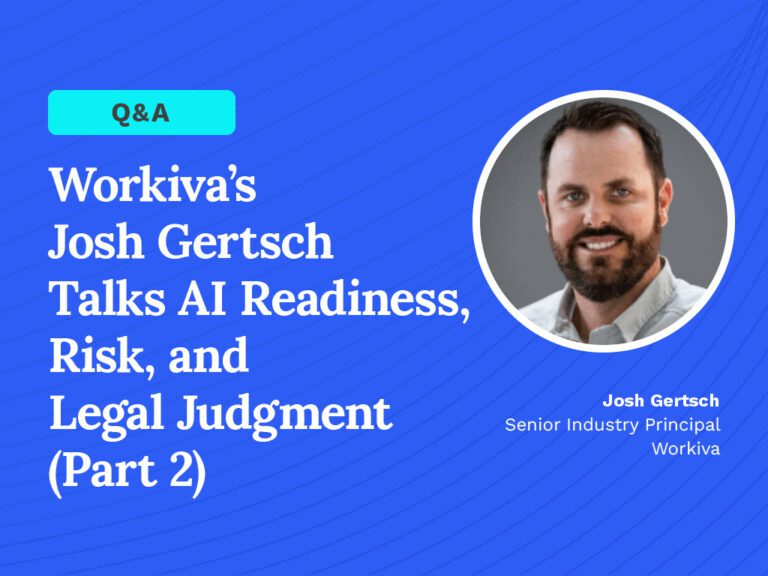
Josh Gertsch is a senior industry principal at Workiva, where he supports capital markets teams navigating complex transactions. With a background in law and accounting, he focuses on applying technology to streamline deal workflows, reduce risk, and improve collaboration across legal, finance, and compliance functions.

Sponsored Content
Presented by Workiva
In the second part of this interview with Workiva’s Josh Gertsch, the executive continues our discussion about AI readiness and legal teams. This part of the conversation touches on how technology is transforming legal workflows on areas such as M&A due diligence, annual reporting, and IPOs. The first part of this interview can be found here.
To make this more concrete for our audience, it helps to break down how technology and AI apply in practice across different legal roles. Law firm attorneys and in-house legal teams face distinct pressures in areas such as capital markets, M&A, securities reporting, sustainability, and governance, risk, and compliance—and the ways technology can reduce risk, improve coordination, and drive efficiency vary meaningfully across these areas.
For example, strategic growth, whether through M&A or capital-raising transactions like IPOs, has been a major focus for companies in 2025 and is expected to continue into 2026. These transactions place significant demands on legal teams for diligence, drafting, and integration. From your perspective, where can technology make the biggest impact for attorneys on either side of a deal?
Josh Gertsch: Across nearly every transaction, whether M&A, IPOs, or other capital-raising events, the area that consistently consumes the most time is due diligence.
On any deal, you have a buy side and a sell side, each with counsel and subject-matter experts, plus the company in the middle responding to a constant flow of questions. Due diligence is where the friction really lives. It’s common to receive 50 or more requests that need to be answered, supported, and refined, a process that can stretch on for months, or even years, before a deal is fully defined.
Organizations may not always be actively drafting or negotiating, but many are continuously evaluating strategic options. For smaller companies, that might mean founders considering a sale or raising institutional capital. For private equity-backed companies, it may be whether to go public or pursue a different exit. For large conglomerates, it’s acquisitions, divestitures, and portfolio reshaping. Across all of these scenarios, the demands on legal teams are significant.
This is where technology, and especially AI, can have an outsized impact. Historically, technology has largely been used to store and secure information—upload documents, grant access, and move on. What’s changing is that AI can actually work with that data, generating summaries, identifying patterns, comparing against peer data, and surfacing insights that matter.
AI won’t replace judgment on the most complex or sensitive issues, but it can dramatically accelerate analysis. It helps advisors quickly identify where to focus. If a summary flags a technical issue, an attorney can immediately zero in and pull the relevant documents. Instead of reviewing everything equally, they can direct effort where it matters most. That’s where the real value shows up.
We’re at a real transition point. There’s significant investment flowing into the due diligence space because the opportunity is so clear. If firms can securely house highly confidential information and apply AI in a controlled way, they can cut weeks or months off deal timelines. That efficiency doesn’t just affect individual transactions; it can meaningfully change the speed at which deals move through the broader economy.
When you step back and look at the broader deal landscape, there are roughly 30,000 private companies in the U.S. and another 6,000 to 7,000 public companies—close to 40,000 organizations constantly considering some form of transaction. At that scale, even incremental efficiency gains compound quickly, reinforcing why advisors across law firms and accounting firms are investing so heavily in this space.
We’ve seen a significant resurgence in capital markets activity and IPOs in 2025, and deal teams are busier than ever. Drafting, reviewing, and filing a registration statement is a massive undertaking that involves attorneys across both law firms and in-house teams. From your perspective, what pain points or workflow challenges are best addressed through technology?
Josh Gertsch: Technology can help with the project and workflow management itself, especially around deadlines and status tracking. It really does that in two ways. First, it provides visibility. Instead of relying on an Excel spreadsheet that gets emailed to 50 people and manually updated, technology can act as a centralized project management layer, almost like a built-in project management office (PMO), capturing where things stand at any given moment.
That visibility matters because everyone can see progress in real time and understand dependencies. In deal work, it’s common to hear, “Legal has it,” or “Accounting is reviewing it,” without any real clarity on what that actually means. Sometimes a document has been sitting untouched for a week, and then a call comes in, pressure ramps up, and it gets turned around in an hour. Technology helps surface those bottlenecks earlier and, frankly, drives accountability. When everyone can see where things are stuck, behavior changes.
That accountability is especially important in transactions. No one wants to be the advisor holding up a deal, particularly when there’s a $500 million check on the line. Those are intense conversations, and visibility into the workflow helps prevent those situations.
The second major benefit is real-time collaboration. You simply can’t operate effectively by emailing documents to dozens of stakeholders, collecting redlines, and then spending days consolidating changes. Deal timelines are too compressed for that. Everyone needs to work in the same document, see each other’s changes as they happen, and immediately understand whether a change affects their area. Data points also need to stay consistent across sections. There’s no room for version drift.
At this point, documents can’t be stale. They have to be live. An attorney in Tokyo should be able to review something overnight so someone in New York can pick it up in the morning, and a team in San Francisco can continue working when they come online. That kind of continuous, global workflow is now the baseline. Static tools and outdated processes just don’t work anymore.
Another major area of focus for attorneys, both at law firms and in-house for public companies, is supporting ongoing quarterly and annual reporting. This includes assessing business risks and ensuring compliance with SEC reporting and disclosure requirements. How is technology evolving to support legal teams in this space?
Josh Gertsch: This really comes down to aligning external and internal data. Every company is constantly assessing business risks and looking at how peers are communicating similar issues. Technology now makes it much easier to gather external data—market intelligence, competitor disclosures, industry trends, and even emerging regulatory developments—and bring that information in quickly.
On the internal side, it’s about pulling data from across the organization and building a bottom-up view of what’s actually happening inside the business. Where is the data housed? How does it map to what’s happening in the market? The real evolution is happening at the intersection of those two streams.
This is where AI starts to play a meaningful role. Technology can structure both external and internal data within a single platform, and AI can then help analyze, compare, and contextualize that information. While SEC reporting is an obvious example because of the volume and scrutiny involved, the same approach applies more broadly.
Whether a company is preparing a quarterly earnings report, an annual filing, a press release, or another external communication, the goal is the same: align what’s happening internally with how the company is presenting itself externally. Technology helps bring those inputs together, while AI enhances the ability to synthesize and refine them. The result is a more streamlined, consistent, and defensible reporting process.
Regulations continue to evolve rapidly. How can legal teams leverage technology to stay ahead of these changes, manage risk, and ensure effective coordination across multiple stakeholders?
Josh Gertsch: An immediate value technology provides, especially with AI, is helping legal teams make sense of volume and speed. Regulations are constantly being issued, and the initial question is often, “What does this actually mean for us?” Before diving into the full text, attorneys want to know the five things that matter most. Scope it for me first. Tell me whether it applies to my business, and then I’ll decide how deeply I need to go.
AI is well-suited for that. It can summarize new rules, flag applicability, and provide enough context for teams to decide whether immediate action is required or whether it’s something to track and revisit later. That alone makes regulatory change more digestible.
This matters even more given the broader environment we’re operating in. We’re in a period of real geopolitical volatility, and I’ve never seen geopolitics influence regulation as directly as it does now. We’re swinging from one regulatory posture to another, sometimes dramatically, every few years.
Four years ago, we saw heavy regulatory pressure, particularly around areas like sustainability. Now, many of those requirements are being scaled back, with an emphasis on encouraging companies to access public markets and reducing reporting burdens.
Whether those shifts are right or wrong isn’t the point. The reality is that change is happening faster. Timeliness matters more than it used to. In the past, you might have tracked one or two major standards a year. Now, it’s constant. Technology helps teams keep pace by pulling in external regulatory developments, summarizing them, and embedding them into workflows.
Once that information is surfaced, technology can also help operationalize it. It can prompt teams to acknowledge new requirements, create checklists, and ensure those considerations are reflected in policies, controls, and processes. You’re no longer relying solely on an advisor to flag a new rule. The system itself can say, “Here are four things this regulation requires. Have we addressed them?” That kind of structure makes navigating regulatory change far more manageable.
For attorneys working with compliance, internal audit, or risk teams, how can integrated technology platforms help harmonize workflows across governance, risk, and compliance functions? Where do you see the biggest opportunity to reduce friction and improve visibility?
Josh Gertsch: At the core, this still comes back to data. Most of the friction in governance, risk, and compliance stems from fragmented information, external data, internal data, and an inconsistent understanding of how processes actually work. Integrated platforms help bring all of that together.
One of the biggest improvements technology offers is visibility into end-to-end processes. In a former life, I worked on submissions to regulatory agencies, and often the problem wasn’t intent. It was that we didn’t fully understand the process. When an agency came back and flagged an issue, it often revealed a gap between how we thought something worked and how it actually worked.
Technology helps solve that by mapping the full process, from start to finish, and making it visible to everyone. From a risk and compliance perspective, that’s huge. Once the process is clearly defined, technology can highlight where it’s most likely to break down or where risks are concentrated. From there, it can even suggest ways to mitigate those risks, based on available data and prior outcomes.
The real benefit is focus. Instead of trying to manage every possible risk equally, teams can concentrate on the areas that matter most. You may not catch everything, but you’re far more likely to avoid the big failures like a data privacy incident, major compliance lapse, or the issue that leads to meaningful penalties.
There’s also an important defensibility element here. In most regulatory or legal scrutiny, the standard isn’t perfection but reasonableness. If you can demonstrate that you understood the process, identified risks, thought through your options, and made informed decisions, that goes a long way. Even if a regulator or court disagrees with your conclusion, the severity of the outcome is often much lower if you can show you weren’t negligent.
Technology helps make that visible. It documents the thought process, the controls, and the decisions along the way. That proof of reasonable effort is incredibly powerful, both from a legal and risk management perspective.
Sustainability has become a major area of focus in recent years. Where do you see the legal function playing a larger role in this space, and how can technology help attorneys ensure accuracy, manage risk, and prepare for emerging assurance and regulatory requirements?
Josh Gertsch: Sustainability introduced something that, frankly, pulled legal teams much more directly into the conversation, and that’s the mix of financial and non-financial data. Many sustainability disclosures rely on metrics and narratives that historically weren’t subject to audit or rigorous review. That alone introduces risk.
Companies are talking about sustainability, but they’re often talking about it in multiple places. A public company might disclose one metric in a press release, frame it slightly differently in a sustainability report, and describe it again in investor communications. If those statements don’t align, legal is going to get the call. That inconsistency creates exposure, whether it comes from regulators, investors, or other stakeholders.
The intent behind sustainability reporting is generally good. Teams are trying to think long-term, be responsible stewards, and communicate beyond pure financial performance. But once you start combining financial data, non-financial metrics, internal data, and external narratives and distributing them across multiple reports, the risk profile changes quickly.
This is where technology matters. It can help centralize those data points, flag inconsistencies, and prompt review when the same metric appears in different disclosures. Sustainability also cuts across departments, which means legal has to manage a broad set of stakeholders. Visibility and coordination are critical.
At the end of the day, sustainability creates a different kind of risk, but it’s still fundamentally a data and workflow problem. Technology helps attorneys reduce the risk of inconsistent or unauthorized disclosures and ensures that what goes out publicly aligns with what’s been reviewed and approved.
As we wrap up, what parting advice would you offer to legal teams—both in-house and at law firms—as they think about preparing for the future of capital markets, regulatory reporting, and the increasing role of technology and AI? What should attorneys prioritize as they navigate this evolving landscape?
Josh Gertsch: Our view is that AI is the catalyst for what comes next. Automation has been building for years, but AI is accelerating everything: the pace, the investment, and the expectations. Companies are spending real money on this now, and they’re going to want results.
From the technology side, the pressure is intense. Platforms that don’t adapt over the next two to three years risk becoming obsolete. You either emerge as a credible, trusted AI-enabled platform, or you don’t make it. That same pressure exists for legal teams adopting technology.
AI is here to stay, but for attorneys, the first realization must be this: successful AI adoption is fundamentally a data challenge. There’s no going back. AI will change how legal work gets done, but it only works if you understand your data. Where it comes from, how it’s governed, and how it can be used safely. Solve that problem first, and everything else accelerates.
The second priority is usability. Legal teams have varying levels of comfort with technology, so tools must feel intuitive from the start. If a platform requires months of heavy enablement just to be usable, it won’t stick—there simply isn’t room for that anymore. That said, the most effective technologies are also worth investing time in. They should be intuitive enough to adopt quickly, yet powerful enough that teams are willing to build proficiency over time without introducing risk or confusion downstream
Once you solve for clean data and intuitive access, the opportunity for AI becomes real. At that point, it can be a genuine accelerator for legal practices. If you don’t, it risks becoming a roadblock. The difference between acceleration and roadblocks will determine which teams are prepared for what’s coming next.
Read the first part of the interview here.
Must read intelligence for general counsel
Subscribe to the Daily Updates newsletter to be at the forefront of best practices and the latest legal news.
Daily Updates
Sign up for our free daily newsletter for the latest news and business legal developments.