NACD’s Kimberly Simpson Shares How Trust Strengthens the Board-CEO Dynamic
December 3, 2025
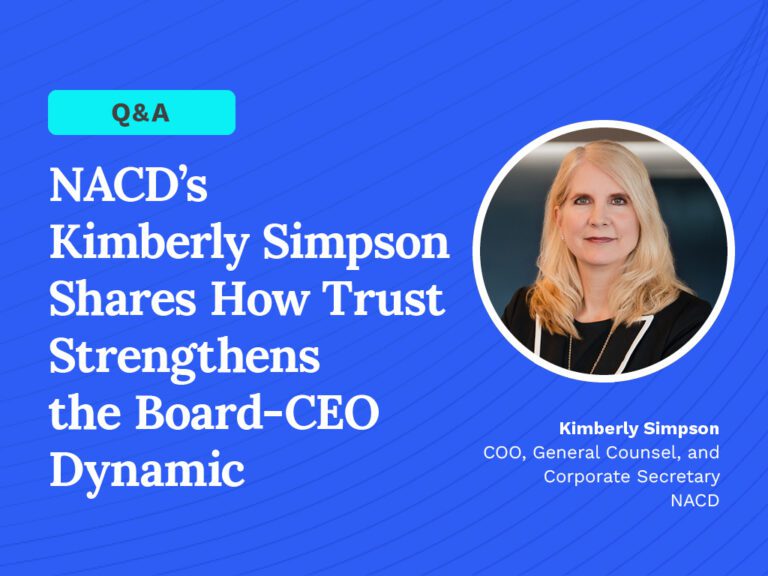
Kimberly Simpson serves as COO, General Counsel, and Corporate Secretary at the National Association of Corporate Directors (NACD) overseeing member engagement, certification programs, chapter networks, marketing, and board search. She supports two boards and frequently speaks and writes on governance.
In this interview, Kimberly Simpson discusses strengthening the board-CEO dynamic as the National Association of Corporate Directors (NACD) releases its 2025 Blue Ribbon Commission Report. With governance expectations rising and GCs navigating dual responsibilities more intensely than ever, she discusses why trust and alignment at the top are now critical to organizational performance. The conversation took place over email.
The NACD’s 2025 Blue Ribbon Commission Report focuses on building a high-trust board-CEO dynamic. From your perspective, what are the most critical elements that define “trust” in that context, and how can general counsel help reinforce it?
Kimberly Simpson: Businesses are facing disruption at a speed and scale that requires boards and management teams to be more agile than ever. This requires a high level of trust, built over time, that can be leveraged to drive a high-functioning organization forward. NACD’s Blue Ribbon Commission agreed that, at the end of the day, success all comes down to people and the strength of their connection.
While the general counsel cannot manufacture personal chemistry between the board and CEO, they can strengthen the systems that make trust sustainable. General counsel have an important role in applying the governance framework and cadence that underpins the human element of trust. For example, elements include board agenda management to maximize time for strategic discussions; championing and scheduling routine executive sessions at the beginning and end of meetings; promoting regular discussions between the CEO and board between meetings; supporting the nominating and governance committee in the selection of the right board members; and promoting proactive information flows to prevent surprises.
The general counsel and/or the corporate secretary play a critical role in preparing materials that help shape the board’s culture, supporting candid and strategic discussions, monitoring adherence to board policies and procedures, and ensuring the board and management visit the subjects of delegation of authority and role delineations. They can facilitate thoughtful board assessments and model continuous improvement and constructive reflection by always asking, “How can we do this better?” They may also play an important role in crisis situations where trust can be tested.
Many general counsel find themselves in a difficult position: reporting to the CEO while also holding fiduciary duties to the board. What strategies have you found most effective in maintaining this balance while keeping both relationships transparent and productive?
Kimberly Simpson: Ultimately, the general counsel’s duty runs to the corporation, but balancing dual accountability to the CEO and the board in most situations comes down to trust. When trust exists among the CEO, general counsel, and the board, transparency tends to follow naturally. But this is easier said than done. The general counsel’s role is to maintain that “triangle of trust” by ensuring communication is open, consistent, and predictable, helping the board and CEO make informed decisions and stay strongly aligned.
Challenges can arise when any side of that triangle feels excluded or blindsided. The general counsel can prevent this issue by keeping both the CEO and the board (particularly the nominating and governance chair) informed of key issues and discussions, and by serving as a translator when needed to help the board and CEO understand each other’s perspectives.
Of course, if there’s any impropriety, the general counsel has a clear duty to step in. But in most situations, the goal is to avoid surprises and maintain alignment. Even small habits, such as deciding when to copy the CEO on board correspondence and defining roles in advance, can help reinforce mutual trust. Over time, those practices create a culture where transparency is expected, and relationships can thrive.
The report highlights that a strong board-CEO partnership leads to a stronger company. Could you share examples of how that trust-based collaboration translates into better decision-making or risk management outcomes?
Kimberly Simpson: A strong board-CEO relationship translates into two important outcomes: one, it creates strategic value, and second, it prevents value from eroding. A poor board-CEO relationship can lead to less effective meetings, difficulty making decisions, and more blind spots, all of which create more risk. For example, when the relationship breaks down, the board may feel that it needs to lean in more. This causes management to divert its energy to managing the board rather than the business.
By contrast, when trust is strong, information flows early and openly. The CEO feels comfortable bringing emerging issues and ideas to the board early. The board, in turn, offers informed guidance and then allows management to execute without second-guessing. In an ideal world, this is how the trust triangle works.
That kind of collaboration improves both the speed and quality of decision-making, which is so important in today’s business climate. It also allows the company to fully benefit from the directors’ expertise, as those board seats represent significant strategic value. When trust is high, the board’s collective experience is put to work for the company rather than wasted on managing tension.
As governance expectations evolve, what role should general counsel play in fostering open communication and alignment between the CEO and board, especially when tensions or conflicting priorities arise?
Kimberly Simpson: The general counsel’s ability to foster alignment between the board and CEO depends on their standing in the organization. When viewed as a strategic partner, the general counsel can act as a quiet mediator, someone trusted by both sides to surface issues early, be a truth-teller, frame issues constructively, and maintain steady communication when tensions rise.
In practice, this means reinforcing the governance cadence, even when the business faces challenges. Working with board leadership to promote executive sessions and to clear away the box-checking agenda in favor of strategic discussions can help prevent the board-CEO relationship from breaking down under pressure.
The general counsel can also influence outcomes through committee channels, particularly by engaging the nominating and governance chair to encourage more thorough board evaluations or by assisting the CEO in preparing for sensitive conversations. Conflict can also be addressed through education. NACD’s report suggests that the general counsel, who often manages director onboarding and education, works with the nominating and governance chair and CEO to provide regular briefings, recommend training, and bring in outside experts.
In moments of real crisis, prior planning and processes have a tremendous impact. For example, a playbook that outlines how and when the board will be briefed keeps the focus on resolution rather than reaction. Ultimately, the general counsel‘s role is to maintain trust and structure in good times and bad so that both the board and CEO can lead effectively.
Looking ahead, what key takeaways or actionable recommendations from the Blue Ribbon Commission Report would you most want GCs and corporate leaders to apply within their organizations?
Kimberly Simpson: The Blue Ribbon Commission’s nine recommendations are aimed at the board and CEO, but the general counsel underpins their success. The general counsel ensures that governance structures, processes, knowledge, and communication routines are strong enough to support trust and effective collaboration at the top.
The general counsel serves as a catalyst for the board’s continuous improvement, creating an environment where everyone works toward a stronger board dynamic. Board culture is a real phenomenon, just as company culture is. From a practical standpoint, the underpinning of a strong board culture means maintaining disciplined board operations, reinforcing transparency between the CEO and directors, and creating the conditions for candid dialogue.
Ultimately, the Blue Ribbon Commission report’s biggest takeaway for general counsel is to view their role not only as legal advisers but as enablers of high-functioning governance. When the board and CEO operate in sync, it’s often because the general counsel has built the systems and relationships that allow trust to thrive.
Must read intelligence for general counsel
Subscribe to the Daily Updates newsletter to be at the forefront of best practices and the latest legal news.
Daily Updates
Sign up for our free daily newsletter for the latest news and business legal developments.